|
| | Egypt Mosques
The Mosque of Amr Ibn El-As
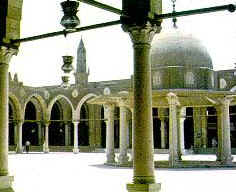
This is the first and oldest mosque ever built on the land of Egypt. Erected
in 642 AD (21 AH) by Amr Ibn al'As, the commander of the Muslim army that
conquered Egypt, the mosque is also known as Taj al-Jawamie (Crown of Mosques,
al-Jamie'al-Ateeq (the Ancient Mosque) and Masjid Ahl ar-Rayah (Mosque of Banner
Holders).
The mosque is said to have been built on the site of Amr Ibn el-As's tent at
Fustat, is the oldest existing mosque, not just in Cairo, but the entire African
Continent. Located north of the Roman Fortress of Babylon, it is actually on the
edge of Fustat, the temporary city founded by Amr, and was an Islamic learning
center long before El-Azhar Mosque. It could hold up to 5,000 students.
The mosque was originally built on an area of 1,500 square cubits, overlooking
the Nile. The initial structure was quite simple; with walls bare of any plaster
or decorations, but without niche (miharb), minaret or ground cover. It had two
doors on the north and two others facing Amr's house.
The mosque area remained unchanged until 672 AD (53 AH), when Musallama al-Ansari,
Egypt's ruler on behalf of Caliph Mu'awiya Ibn abi-Sufian undertook expansion
and renovation works for the mosque. Walls and ceilings were decorated and four
compartments for "muezzins" (callers for prayers) were added at the
corners, together with a minaret, while the mosque ground was covered with straw
mats.
In 698 AD (79 AH), the mosque was demolished and expanded by Abdul-Aziz Ibn
Marwan, Egypt's ruler. Once again in 711 AD (93 AH), the mosque was demolished
by Prince Qurrah Ibn Shuraik al-Absi, Egypt's ruler. Upon the orders of Caliph
al-Waleed Ibn Abdul-Malek, the mosque area was enlarged, a niche, a wooden
pulpit (minbar) and a compartment and copings of four cloumns facing the niche
were gold-coated. The mosque had then four doors to the east, four to the west
and three to the north.
Under the Abbasid state, successive additions and repairs were introduced. In
827 AD (212 AH), Abdullah Ibn Taher, Egypt's ruler on behalf of Caliph
al-Ma'moun ordered an equivalent area to the north to be added to the mosque,
thus bringing its total area to its present level of 13,556,25 square metres.
(112.3m x 120.5m). However, the Fatimid period was the gold era for the mosque,
where gilted mosaics, marble works, a wooden compartment and a moving pulpit
were introduced and part of the niche was
silver-coated. The last structural amendments in Amr Mosque were made during the
rule of Murad Bey under the ottoman era, in 1797 AD (1212 AD). Because of the
collapse of some columns, the interior of the mosque was demolished and rebuilt.
As a result, eastern archades were repositioned so as to be perpendicular to the
mihrab wall. Accordingly, arches were extended across windows. Two minarets were
built and are still extant.
Amr Mosque was not merely a place of worship but also served as a court
for settling religious and civil disputes. Moreover, teaching circles were
organized either for general religious preaching or teaching lessons in Quranic
sciences, jurisprudence and Prophet Muhammad's Tradition (Hadith) as well as
letters.
The mosque incorporates elements of Greek and Roman buildings, and has 150 white
marble columns and three minarets. Simple in design, its present
plan consists of an open sahn (court) surrounded by four riwaqs, the largest
being the Qiblah riwaq. There are a number of wooden plaques bearing Byzantine
carvings of leaves, and a partially enclosed column is believed to have been
miraculously transported from Mecca on the orders of Mohammed himself. There are
many other ancient legions related to the
Mosque.
Back to Mosques in Egypt
| |
|
 Egypt
Gift Shop
Egypt
Gift Shop