The boy king, Tutankhamun 's
Life, Tomb and Treasures
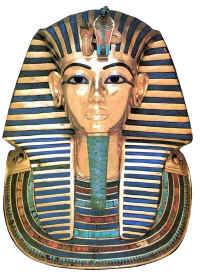
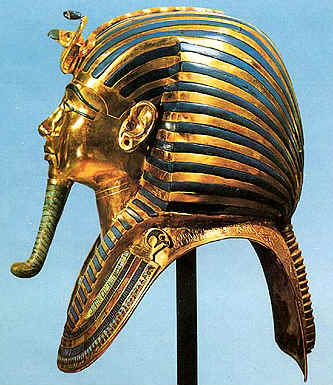
Golden mask of King Tutankhamun
Tutankhamun or King Tut ascended to the throne when he was nine years old that's why he
might be known as the boy king. He is the pharaoh
who holds a prominent position in the history of Egypt. Not because of his power
or greatness, but for the fact that his grave was the only one that was not
exposed to robbery. Tutankhamun reigned in 1300 BC almost a decade as a
marionette of the priests.
For a long time it was believed that Tutankhamun died from tuberculosis at a
very young age. Modern X-ray technology shows a wound on the right backside of
the skull. The priests may have been in such a hurry they could not await his
tuberculosis, but had to strike him dead.
Tutankhamun's tomb was discovered in the Valley of Kings by the British
Egyptologist Howard Carter who was excavating on behalf of his patron Lord
Carnarvon in November 1922. Today, the tomb still contains the pharaoh's
remains, hidden from view inside the outermost of three coffins.
The name "Tutankhamun" is derived from the hieroglyphs which
translate as Tut-ankh-amun meaning the "Living Image of Amun." Today,
many people refer to him as Tut.
King Tutankhamun's treasures
There is probably no more famous group of artifacts in the world then those
associated with the discovery of the tomb of young King Tutankhamun. Among these
treasures are
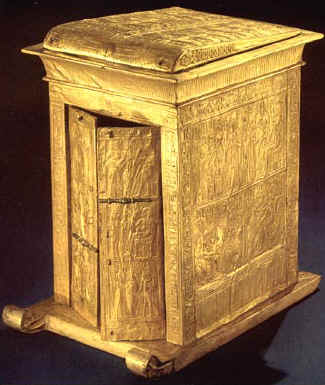
- Furniture and Boxes
- Golden mummy mask of Tutankhamun
- Coffin of wood overlaid with gold and semiprecious stones
- Wood shrine overlaid with gold sheet
- Jewelry and Ornamentation
- Statues and sculptures
Most of the treasures of King Tut are in the Egyptian museum in Cairo and the rest remain
in his tomb in the Valley of Kings in Luxor.
Howard Carter's discovery of Tutankhamun's tomb
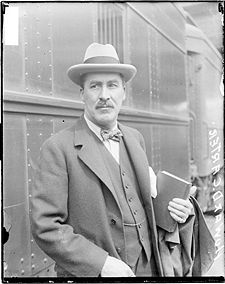 The
discovery of king tutankhamun's tomb was a great event in 1923 that made
Carter a prominent figure in modern history. Although the discovery may
have been by mere luck, it gave Carter an attention that no
archaeologist have received before. Howard Carter was born on May
9th, 1874 in the small town of Kensington, London, England His father
was an artist who drew portraits for local landowners, taught Howard the
fundamentals of drawing and painting. but Howard Carter developed an
early interest in Egypt, so when he was 17 years old, he traveled
to Alexandria, Egypt. he hoped to work with the Egyptian Exploration
Fund as a tracer. Tracers copied drawing and inscriptions on paper for
further study. The
discovery of king tutankhamun's tomb was a great event in 1923 that made
Carter a prominent figure in modern history. Although the discovery may
have been by mere luck, it gave Carter an attention that no
archaeologist have received before. Howard Carter was born on May
9th, 1874 in the small town of Kensington, London, England His father
was an artist who drew portraits for local landowners, taught Howard the
fundamentals of drawing and painting. but Howard Carter developed an
early interest in Egypt, so when he was 17 years old, he traveled
to Alexandria, Egypt. he hoped to work with the Egyptian Exploration
Fund as a tracer. Tracers copied drawing and inscriptions on paper for
further study.
In 1891 He was hired by the Egypt Exploration Fund in London to help
P. E. Newberry with the epigraphic recording of tombs at Beni Hasan and
El-Bersha, in Middle Egypt.
At the beginning of 1900 Howard Carter was appointed Chief
Inspector of Antiquities to the Egyptian Government. He stayed in that
job until 1904.
In 1905, Lord Carnarvon became interested in Egyptian
antiquities and decided to finance some archaeological work. He hired
Howard Carter to conduct the archaeological works which gave its reward
in 1922 with the discovery of the tomb of Tutankhamun.
Books and DVDs
|
|
Tutankhamun and the Golden Age of the Pharaohs:
Official Companion Book to the Exhibition sponsored by National
Geographic ~ Zahi Hawass
- Hardcover: 287 pages
- Publisher: National Geographic (June 1, 2005)
- Language: English
- ISBN-10: 0792238737 ISBN-13: 978-0792238737
- Product Dimensions: 11.6 x 9.5 x 1 inches
|
|
|
Mysterious boy king Tutankhamun returns to the
U.S. in 2008, bringing rare treasures never before seen outside
Egypt. For the millions of fans wanting a keepsake and chronicle
of this magnificent new exhibition, this book will delight.
Created by world-renowned art historians under the guidance of
Zahi Hawass—director of Egypt’s Supreme Council of Antiquities
and a well-known media personality—it surveys 3,000 years of
ancient Egyptian history by focusing on the lives and lifestyles
of great pharaohs.
- Hardcover: 264 pages
- Publisher: National Geographic; illustrated edition
edition (September 16, 2008)
- Language: English
- ISBN-10: 1426202644
- ISBN-13: 978-1426202643
More Books on Tutankhamun
|
|
 Egypt
Gift Shop
Egypt
Gift Shop